




'Potager' is a French word referring to a kitchen garden which provides all the ingredients necessary to make a healthy daily 'potage' or soup. Potager gardening is an ancient French method of growing fruit and vegetables, usually in an ornamental layout, protected by an abundance of flowers and herbs.
The first Potagers where created in French medieval monasteries and were full of herbs growing alongside vegetables, not only for adding flavour to the soup but for their healing and medicinal values, as well as their beauty and scent.
Charlotte created The English Potager Garden to show people in the UK how this attractive, ecologically friendly concept allows one to grow fresh, nutritious food without sacrificing the beauty of an ornamental garden.
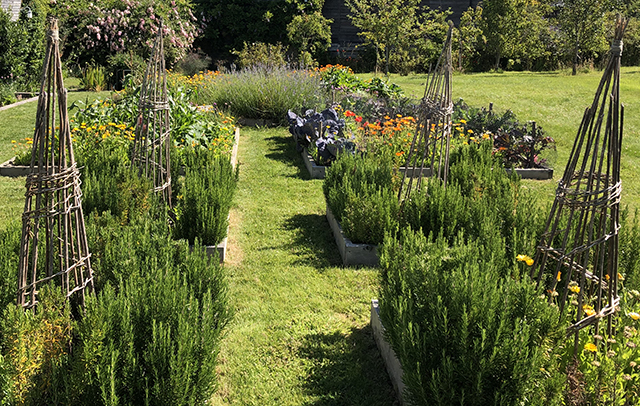
The Potager she made is at the heart of The Sustainable Garden in south Devon. The fruit and vegetables thrive amongst flowers and herbs that are not only attractive, but act as companion plants to nourish and protect the food by attracting beneficial insects and repelling unwanted pests and diseases.
The Potager is in turn surrounded by the orchards, wildflower meadows, grasslands, hedgerows and trees, which provide a species-rich ecological haven that supports a biodiverse mix of flora and fauna, including pollinating insects, birds and butterflies.
The English Potager Garden demonstrates how you can grow wonderful veg in a beautiful way, how to make the most of your natural resources, no-matter how big or small, to create a beautiful sustainable and productive garden that provides much-needed habitats and food for the birds and the bees, while nourishing body and soul along the way.
 How do Potagers differ from other kitchen gardens?
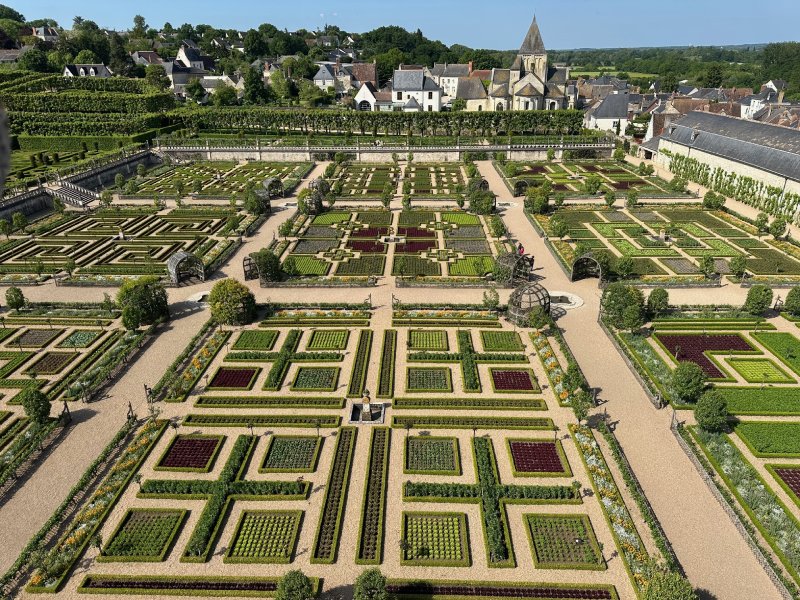
Unlike more utilitarian English vegetable gardens, where vegetables are often grown in rows surrounded by bare earth, a Potager garden is more artistically designed, with beds laid out in attractive patterns, using symmetrical shapes. Vegetables may be chosen for the colour or shape of their leaves, as well their taste, and are often placed in coordinated groupings or patterns, in contrasting or complimentary colours for ornamental effect.
The Renaissance Potager at Villandry (below left) is one of the most famous examples in France, but they don't need to be so formal! Potagers can be relaxed and naturalistic, but they often have common features that give structure and flow to the design, including defined boundaries, attractively shaped beds, structures like obelisks, archways and espaliered or lollipop-shaped fruit trees.
 The flowers used in abundance around the vegetables and herbs in potager gardens not only make it look beautiful, but act as companion plants, bringing in beneficial insects for pollination, while repelling unwanted pests. This is important because it helps negate the need for pesticides, increasing the sustainability of your kitchen garden.
Soil health is carefully maintained by using no-dig methods and home-made composts and natural fertilisers. No chemicals have been used in The English Potager Garden, nor the surrounding land since we arrived in 2015, and consequently natural biodiversity abounds, both in flora and fauna, including birds, butterflies and bees and a host of many other beneficial insects.
Why make a POTAGER garden?
With growing evidence that industrialised agriculture is significantly contributing to climate change it's more important than ever to think about where your food comes from and how it is grown. Pesticide use in farming and horticulture is wide-spread and has a knock-on detrimental effect to many other species, including human health. The Pesticide Action Network (PAN) regularly compiles a list, from government tests entitled the Dirty Dozen which shows that a "cocktail of pesticides" are being used on large numbers of salads, herbs, veg and fruit.
Instead of this, imagine walking around your own garden where beautiful flowers are mixed in with fruit, vegetables and herbs that attract bees and other pollinators, and making your garden hum with life. As you stroll around, enjoying this visual feast, you can pick your own nutritious fruit, vegetables and herbs, free from food miles and chemicals, to make an actual home-made feast from your healthy home-grown. What could be more satisfying?
Creating your own Potager garden not only provides 'soup' for your body, but food for your soul!
If you would like Charlotte's help to create a Potager Garden please go to the CONSULTANCY page for more information.
Choose which categories of cookie you are happy for us to use. Strictly necessary cookies are always on because the site cannot work without them. Your choice is stored for six months and you can change it whenever you like.
These cookies are required for the website to function and cannot be switched off. They are usually set only in response to actions you take, such as logging in, filling in a form, or setting your privacy preferences. They do not store any directly identifying information.
| Cookie | Provider | Purpose | Expires |
|---|---|---|---|
bcc_consent | thesustainablegarden.com | Stores your cookie preferences so we do not ask again on every page. | 182 days |
PHPSESSID | thesustainablegarden.com | Keeps your session state on the server while you browse. | Session |
wordpress_logged_in_* | thesustainablegarden.com | Keeps you signed in as you move between pages of the site. | Session / 14 days |
wordpress_sec_* | thesustainablegarden.com | Authenticates you in the site administration area over a secure connection. | Session / 14 days |
wordpress_test_cookie | thesustainablegarden.com | Checks that your browser accepts cookies before showing the login form. | Session |
wp-settings-* | thesustainablegarden.com | Remembers your personal admin screen layout preferences. | 1 year |
wp-settings-time-* | thesustainablegarden.com | Records when your admin screen preferences were last changed. | 1 year |
These cookies enable extra functionality and personalisation, such as remembering your choices, embedded videos, live chat and maps. If you do not allow them, some or all of these features may not work properly.
| Cookie | Provider | Purpose | Expires |
|---|---|---|---|
comment_author_* | thesustainablegarden.com | Remembers your name and email so you do not have to retype them when commenting. | 1 year |
These cookies let us count visits and traffic sources so we can measure and improve how the site performs. They tell us which pages are the most and least popular and how visitors move around the site. All information is aggregated and therefore anonymous.
| Cookie | Provider | Purpose | Expires |
|---|---|---|---|
_ga | Google Analytics | Assigns a randomly generated number to your browser so Google Analytics can tell returning visitors from new ones. | 2 years |
_ga_CZFFWC4P2J | Google Analytics | Stores and counts page views for a specific Google Analytics 4 property. | 2 years |
These cookies may be set through our site by our advertising partners to build a profile of your interests and show you relevant adverts on other sites. They do not store directly identifying information but are based on uniquely identifying your browser and device.
| Cookie | Provider | Purpose | Expires |
|---|---|---|---|
_gcl_au | Google Ads | Used by Google AdSense and Google Ads to record and report on advert conversions. | 90 days |
_gcl_ls | Google Ads | Stores advert click information so a later purchase or enquiry can be credited to the advert. | 90 days |